
Meet Subaru's Redesigned 2026 Outback In Deep Emerald Green Pearl
The 2026 Subaru Outback arrives as an all-new generation, trading in its familiar wagon profile for a taller, more upright SUV silhouette. From the crisp new front end to a restyled interior with more passenger and cargo room, the core ingredients that defined earlier Outbacks remain. In Deep Emerald Green Pearl, the new shape and shade showcases the shift into midsize-SUV territory.
Compared with the 2025 model, the change in stance is striking. The previous Outback was already taller than a traditional wagon, but its roofline and long, low greenhouse still nodded to its Legacy-derived roots. For 2026, the body stands about an inch and a half higher, with a more squared-off roof, chunkier fenders, and a front end built around stacked lighting units that visually push the design toward the SUV side of the spectrum. Road tests note that wheelbase and overall length are essentially unchanged, yet the added height and boxier proportions give the new Outback a noticeably larger, more assertive presence. (Subaru)
The styling revisions go beyond a taller roof. Subaru’s feature breakdown highlights a more vertical front fascia with a newly shaped grille, a split-headlight layout, and available 19-inch wheels that fill the arches in a way earlier Outbacks never did. Body-side surfacing is cleaner and more architectural, with a stronger shoulder line and simplified cladding that still reads rugged but less busy than before. At the rear, a more upright tailgate and revised lighting signatures tie the design closer to Subaru’s latest SUVs while preserving the easy-loading cargo opening that made the Outback a staple for outdoor-focused households. (Subaru)
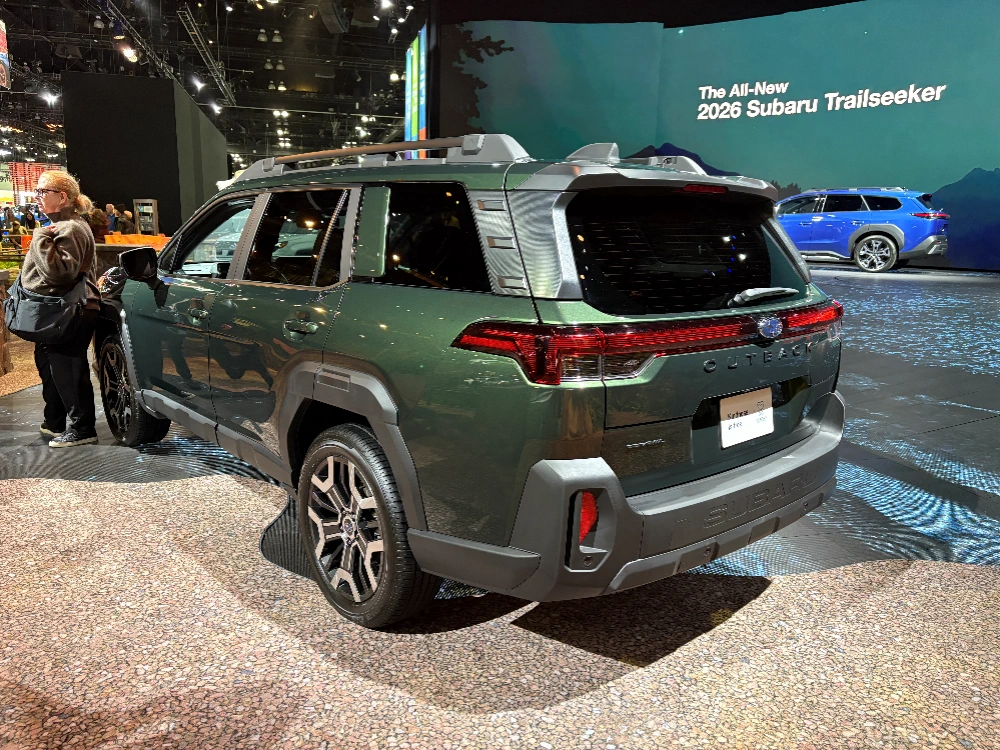
Deep Emerald Green Pearl plays directly into that new shape, and Subaru’s own gallery leans on it heavily for Touring-trim imagery. On the taller, boxier 2026 body, the color comes across as a rich, saturated green with metallic depth, dark enough to read sophisticated in low light but bright enough in the sun to pick out the Outback’s sharper creases and wheel-arch forms. Against the black lower cladding, bright window trim, and available machined wheels, the paint gives the Outback an almost heritage-SUV character—something between forest trail and downtown curb appeal—that feels well suited to buyers who want an outdoorsy hue without veering into novelty. (Subaru) (Subaru)
Inside, the redesign is equally significant. Subaru replaces the previous vertical 11.6-inch center screen with a new Subaru Multimedia System built around a 12.1-inch touchscreen and pairs it with a 12.3-inch fully digital instrument cluster, both now standard across the lineup. The larger central display integrates wireless Apple CarPlay and Android Auto, cleaner graphics, and improved anti-glare performance, while the cluster can mirror navigation prompts and key driving data directly in front of the driver. First-drive reports also point out the return of dedicated physical controls for climate and seat functions, addressing complaints that the old system buried too many daily adjustments in on-screen menus.
Underneath the new bodywork, the mechanical formula remains recognizable but refined. The 2026 Outback line continues with a naturally aspirated 2.5-liter SUBARU BOXER engine in core trims and a 2.4-liter turbocharged BOXER engine in XT models, with total outputs around 180 horsepower and 260 horsepower respectively, driving all four wheels through a continuously variable transmission. Subaru’s Symmetrical All-Wheel Drive remains standard, with up to 8.7 inches of ground clearance on standard models and as much as 9.5 inches on the Outback Wilderness, plus X-MODE (and dual-function X-MODE on Wilderness) to optimize traction on snow, dirt, and more challenging surfaces. Towing capacity of up to 3,500 pounds continues to give the Outback genuine utility for small campers, boats, or utility trailers. (Subaru) (Subaru)
Trim structure also reflects the Outback’s move further into SUV territory. Subaru organizes the 2026 lineup around six gas trims—Premium, Limited, Touring, Limited XT, Touring XT, and a separately presented Outback Wilderness—each layering on different combinations of appearance, comfort, and technology. Higher-spec versions bring features such as ventilated front seats, upgraded audio, and more intricate interior materials, with Deep Emerald Green Pearl prominently featured on Touring-level imagery to emphasize the model’s more premium aspirations. Across the board, the blend of roof rails, available integrated gear rests, and fold-flat rear seating underscores that the Outback remains a tool for active use even as it becomes more polished inside.
Taken together, the 2026 Subaru Outback represents one of the biggest shifts in the nameplate’s 30-year history: a move toward a taller, boxier, more SUV-like form paired with a thoroughly updated cockpit and a denser web of driver-assistance technology. For long-time Outback fans, that may feel like a departure from the lifted-wagon quirkiness of earlier generations, but the fundamentals—boxer engines, standard all-wheel drive, big ground clearance, and real cargo space—remain firmly in place. In Deep Emerald Green Pearl, the redesigned Outback presents that evolution with an especially appealing blend of outdoorsy character and refined presence, signaling that the familiar adventure-ready Subaru has stepped confidently into its next era.
Autosplainer is for informational purposes only. Best attempts are made to ensure reliability and timeliness of information. Autosplainer does not sell vehicles or offer products or services of any kind for sale.