
Meet Chevy's Latest Corvette In "Sebring Orange"
Sebring Orange has become one of the Corvette palette’s most extroverted statements. It's a finish that makes the car like moving sculpture, even when parked. On a shape defined by hard creases and mid-engine proportions, the color amplifies what Corvette performance personifies. The result is a modern orange supercar carrying the Corvette attitude: brash, precise, and built to be noticed.
In recent model years, Sebring Orange has also functioned as a kind of bridge between generations. Chevrolet has positioned “Sebring Orange” among headline color updates and explicitly ties it to earlier Corvette history, framing it as a returning enthusiast favorite rather than a one-season novelty. That matters because bright colors can sometimes feel disposable in the broader market; here, the message is continuity. Sebring Orange is presented as a deliberate part of the Corvette story, returning at the same time performance variants continue to expand the lineup’s range and ambition. (Chevrolet)
The origin story adds to the appeal. The National Corvette Museum documented Sebring Orange (noted as G26) becoming orderable and described an early production ramp-up tied to paint-shop scheduling, the sort of practical detail that signals a real program rather than a mere concept-car flourish. In other words, Sebring Orange entered the Corvette ecosystem as a serious, production-backed choice—one that could be planned, built, and delivered at volume rather than reserved for a show stand. That grounding has helped the hue feel like a legitimate Corvette signature, not a gimmick.
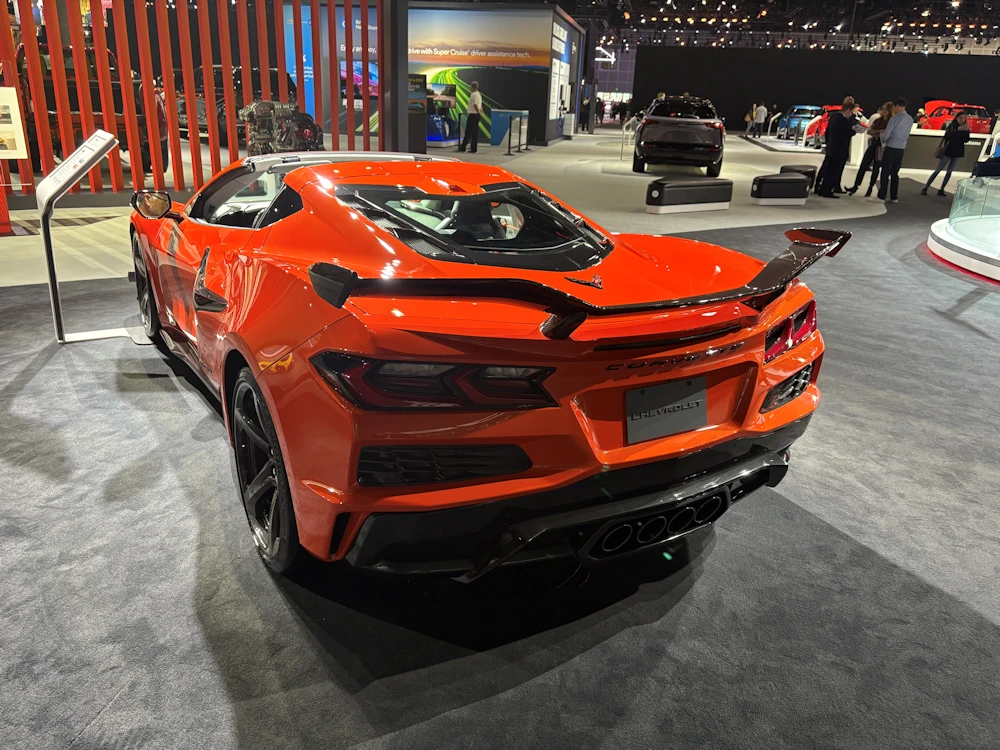
On the Stingray, Sebring Orange can read as pure sports-car theater, because the car itself already balances supercar posture with everyday usability cues. Chevrolet lists the Stingray with up to 495 available horsepower, an available 0–60 time of 2.9 seconds, and a top track speed listed at 194 mph, then pairs those numbers with language about cargo capacity and daily versatility. In orange, that duality becomes the point: dramatic looks paired with a model positioned as livable, not just track-bound. (Chevrolet)
The E-Ray gives the color a different personality, because its performance pitch is tied to electrified all-wheel drive and all-season confidence rather than traditional rear-drive purity. Chevrolet calls it a first-of-its-kind Corvette with an electric front axle working alongside a 6.2L V8, with an available 0–60 time of 2.5 seconds and 655 combined horsepower, and it even highlights modes that allow quiet electric-only movement for short distances at low speeds. Sebring Orange on an E-Ray can feel like a wink: stealth capability wrapped in maximum visibility. (Chevrolet)
For the Z06, Sebring Orange fits naturally with the model’s competition tone. Chevrolet describes Z06 as a street-legal track weapon co-developed with the GT3.R race car, anchored by a 670-horsepower flat-plane crank V8 and a redline listed at 8,600 rpm. The same page emphasizes track-focused systems and performance control tools, framing the car as engineered for precision rather than mere straight-line spectacle. In that context, orange becomes less about fashion and more about signaling intent—an exterior that looks as aggressive as the mechanical narrative reads. (Chevrolet)
At the far edge of the range, Corvette’s highest-output variants turn Sebring Orange into a kind of highlight marker for extreme engineering. Chevrolet presents the ZR1 with an LT7 5.5L DOHC V8 featuring twin turbos and a flat-plane crankshaft, an 8,000-rpm redline, an 8-speed dual-clutch transmission, and standard carbon ceramic brakes—specs that read like an all-out performance manifesto. When a color like Sebring Orange appears in the same environment as those numbers, it reinforces the idea that the finish is meant to match the car’s intensity, not soften it. (Chevrolet)
Looking toward the broader 2026 range, Chevrolet frames the lineup as a set of distinct choices—from Stingray to E-Ray to Z06 to ZR1—while emphasizing reimagined, driver-focused interiors and larger display screens that wrap the cockpit in information and controls. That matters for Sebring Orange buyers because the color is rarely chosen in isolation; it is usually part of an overall “spec” mindset where exterior drama, interior atmosphere, and technology all reinforce the same point of view. In that light, an orange Corvette becomes not just a paint selection, but a complete performance identity expressed at every surface.
Autosplainer is for informational purposes only. Best attempts are made to ensure reliability and timeliness of information. Autosplainer does not sell vehicles or offer products or services of any kind for sale.